
Oxygen control packaging extends snack shelf life when oxygen is a meaningful driver of quality loss, not simply because a pack contains less air. It is most valuable for products with oxidation-sensitive oils, flavor systems that fade or become stale, crisp products exposed to humid distribution conditions, and snacks expected to remain in storage long enough for gradual package failure to matter.
For dry snacks, the quality target is usually broader than microbial safety. A product may remain microbiologically stable yet still fail because it tastes rancid, loses aroma, becomes soft, changes color, or develops an unacceptable texture. Effective oxygen control packaging addresses one part of that risk. It works best when the film barrier, headspace gas, seal quality, product moisture, and distribution environment have been selected as one system.
When oxygen reduction produces a real shelf-life benefit
The strongest case for oxygen control packaging is a snack containing fats or oils that can oxidize during storage. Fried potato snacks, tortilla-style chips, nut mixes, seed-based snacks, extruded products with oil seasoning, crackers with fat-containing inclusions, and coated snacks can all be affected. Oxygen reacts gradually with lipids, producing stale, paint-like, cardboard-like, or rancid notes. The speed of this change depends on the oil type, product formulation, processing history, temperature exposure, light, and the oxygen that reaches the product after packing.
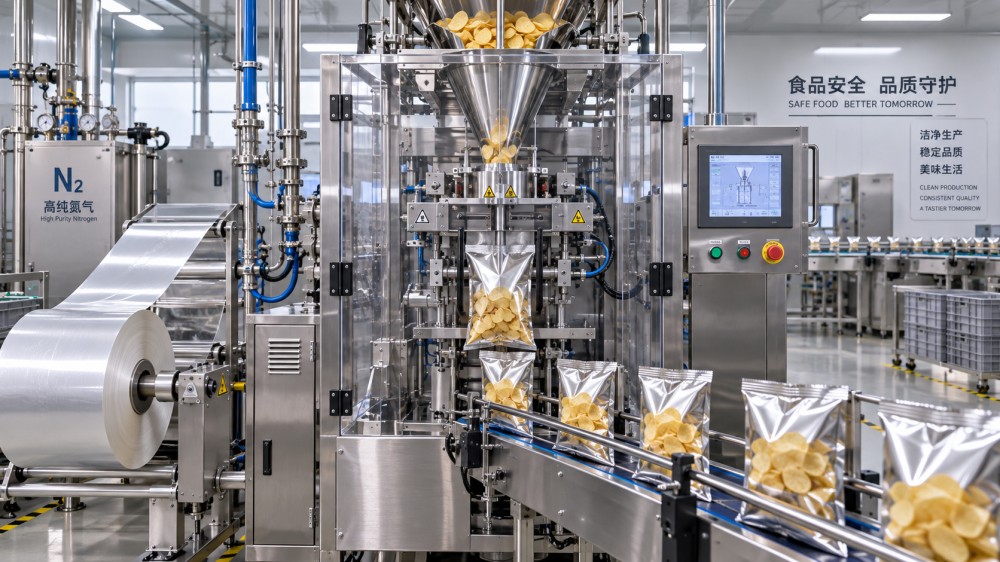
Reducing oxygen in the pack can slow this reaction. Nitrogen flushing is commonly used to displace air before the package is sealed, while a high-barrier structure limits oxygen entering during storage. The two functions are different: flushing lowers the oxygen present at the start, and the packaging material helps maintain that condition over time. Using only one of them may not deliver the expected result.
Oxygen control is also useful when flavor retention is central to the product specification. Delicate seasoning blends, natural flavors, spice oils, dairy-based powders, and some botanical ingredients can lose their intended profile as oxygen exposure increases. A snack might still look acceptable, but a quality panel may identify weakened top notes or an increasingly flat flavor before the end of the intended shelf life. In these products, oxygen management supports sensory consistency rather than merely preventing visible spoilage.
For crisp snacks, the decision requires more care. Oxygen does not usually cause loss of crunch by itself; moisture pickup is often the direct cause. However, a packaging upgrade designed for oxygen protection may also provide better moisture protection, making it useful for both risks. This is common with products such as Panko crumbs, breading blends, seasoned cornmeal, cereal snacks, crackers, and fried coatings. The correct question is not whether nitrogen will keep a product crisp. It is whether the total package system provides sufficient resistance to both oxygen and water vapor for the actual supply chain.
Separate oxidation risk from moisture risk before choosing a pack
A common packaging mistake is to treat every stale snack as an oxygen problem. This can lead to nitrogen flushing being added to a package that still allows excessive moisture transfer. The result may be a bag with low residual oxygen at packing but a product that becomes soft during warehousing or export transit.
Start with the failure mode seen at the end of shelf life. Rancid or oily off-notes, fading aroma, discoloration, and flavor deterioration point toward oxidation control. Softening, loss of fracture, clumping, and changes in powder flow point more directly toward moisture migration. Both may occur in the same product, especially in fried or coated snacks, but they need different performance checks.
Nitrogen can provide a secondary benefit for delicate products by creating a cushion that reduces breakage. That does not make every inflated bag an oxygen-control success. A well-filled bag can still have poor gas displacement, a leaking seal, or an unsuitable barrier film. Packaging appearance is not a reliable substitute for validation.
The package has to retain the atmosphere it creates
Modified atmosphere packaging for dry snacks is often discussed as though it were only a gas-flushing setting on a vertical form-fill-seal line. In practice, the packaging film and seals determine whether the initial atmosphere survives distribution. A low-oxygen headspace measured immediately after production says little about the condition weeks or months later if oxygen transmission or leakage is not controlled.
Film selection should match the product's sensitivity and intended distribution route. A locally distributed, low-fat dry product with short turnover may not require the same barrier construction as an oil-rich snack shipped through hot, humid, or extended export channels. Over-specifying film can add cost and complicate operations without delivering a meaningful shelf-life return. Under-specifying it may create inconsistent quality that cannot be corrected by increasing nitrogen flow.
Seal integrity deserves the same attention as barrier performance. Seal contamination from seasoning dust, crumbs, flour, or oil can create small channels that permit gas exchange even when the film itself has a strong barrier. This is especially relevant on lines packing breading ingredients, powdered coating systems, corn-based meals, and seasoned snack products. A seal may look closed in a visual inspection while still being insufficiently robust under handling stress.
Quality teams should examine the complete sealing window: jaw temperature, dwell time, pressure, film compatibility, product contamination at the seal area, package geometry, and line speed. Changes to any of these variables can alter package performance. The evaluation should also include cases that resemble normal production variation, not only ideal start-up samples.
Residual oxygen is a process indicator, not the shelf-life claim
Measuring residual oxygen after flushing is useful because it confirms whether the packaging line is consistently displacing air. But it is only one control point. A satisfactory reading at pack-off does not demonstrate that the product will meet its sensory, texture, and safety specifications throughout storage.
A practical validation sequence begins by defining the product's actual end-of-life failure criteria. These might include acceptable aroma, oxidation-related flavor, crispness, color, moisture content, package appearance, and seal condition. The next step is to compare packaging options using representative product, normal production settings, and storage conditions that reflect the route to market. Samples should be checked over time, rather than relying only on a day-one gas reading.
For oxygen-sensitive snacks, monitor the relationship between residual oxygen, headspace change, sensory quality, and package integrity. For moisture-sensitive products, pair these checks with moisture or water activity monitoring where appropriate, plus texture evaluation. The aim is not to generate a large amount of test data; it is to identify which failure appears first and whether the chosen package delays that failure enough to support the intended shelf life.
Check where the process can reintroduce risk
Oxygen-control performance can be weakened before the package is even formed. Product held too long after frying or seasoning may already have accumulated oxidation stress. Warm product packed in a humid plant can create later texture problems. Excessive fines can contaminate sealing areas. Inconsistent fill weight changes headspace volume and may affect flushing efficiency. A new seasoning, oil, or packaging supplier can alter shelf-life behavior even if the line settings remain unchanged.
These issues are why package qualification should involve operations, product development, purchasing, and quality functions. The packaging line cannot compensate indefinitely for an unstable upstream process. Conversely, a technically suitable snack may fail at retail because the package was selected based on a short laboratory assessment rather than its true shipping and storage exposure.
Where oxygen control is less likely to justify its cost
Not every snack needs a high-barrier, nitrogen-flushed format. For products with very low oxidation sensitivity, rapid local sale, stable dry texture, and a short practical shelf-life requirement, simpler packaging may be adequate. The decision should be based on the product's likely quality failure and commercial distribution reality, not on the assumption that lower oxygen is automatically better.
It is also a poor substitute for basic product control. Nitrogen flushing will not correct high incoming moisture, poor frying control, deteriorated frying oil, unstable seasoning, inadequate cooling, or weak sanitation. It does not eliminate the need for foreign-material controls, allergen separation, traceability, or appropriate food safety procedures. A package that protects an already compromised product only delays detection of the underlying problem.
For some dry ingredient packs, such as flour, cornmeal, or plain breadcrumb products, moisture-proof packaging may be the dominant requirement, while oxygen control adds value only when the formulation contains oxidation-sensitive materials or the distribution cycle is demanding. A breading blend with oil-rich flavors or dairy components may justify a different approach from plain dry crumbs. Product classification alone is too broad; formulation and use conditions matter.
A workable decision path for snack packaging changes
Before approving oxygen control packaging, document the product, supply chain, and failure mode in a single review. This prevents a packaging decision from being driven solely by a film sample, equipment vendor setting, or one off-flavor complaint.
- Define the quality endpoint. State what must remain acceptable at the end of the intended shelf life: crispness, flavor, aroma, color, powder flow, breakage level, or another product-specific attribute.
- Identify the first likely failure. Distinguish oil oxidation from moisture uptake, seal-related failure, physical damage, or a process issue.
- Map the distribution exposure. Consider storage duration, export transit, heat, humidity, handling, pallet loading, and how long the product may remain in downstream inventory.
- Select the combined control system. Decide whether the product needs nitrogen flushing, an oxygen barrier, a water-vapor barrier, stronger seals, or a combination of these measures.
- Validate on production-representative packs. Include normal variation in product, line operation, and sealing conditions, then evaluate both package performance and product quality over time.
- Set routine verification points. Use relevant line checks for gas performance, fill consistency, seal condition, and finished-product quality. Investigate trends before they become marketplace complaints.
GFCMS coverage of nitrogen flushing, high-barrier films, VFFS packaging, moisture-proof systems, and dry food ingredient protection is useful when this review crosses packaging, coating, milling, and quality-control functions. The relevant comparison is not simply which film has the highest barrier. It is whether the selected system protects the product's most vulnerable attribute under the conditions in which it will actually be sold.
Do not overlook temperature and package handling
Oxygen management is most effective when storage temperature is reasonably controlled. Higher temperatures can accelerate oxidation and can make a previously acceptable packaging design inadequate for a more demanding route. Humidity also matters for crisp and dry products, particularly where secondary packaging or pallet protection is weak. A snack packed correctly at the factory can still arrive with a quality issue if the distribution environment was not considered during validation.
Package abuse deserves attention as well. Pinholes, flex cracking, abrasion, and compression damage can compromise a barrier structure or seal. This risk is higher for export shipments, mixed-load distribution, sharp-edged products, and packs subject to frequent handling. Retained samples stored only in a stable internal environment may not reveal these weaknesses. Review packages after transport simulation or representative logistics handling when distribution damage is a realistic concern.
The practical conclusion is straightforward: oxygen control packaging extends snack shelf life when oxidation is a real limiting factor and the package can maintain its protective atmosphere until the product is consumed. It becomes more valuable when paired with moisture protection for crisp products, sound sealing practices, controlled processing, and validation against the actual route to market. When the primary failure is moisture, process instability, or physical damage, oxygen reduction alone will not solve the problem.
Related News
- When does oxygen control packaging extend snack shelf life?Sep 26, 2026Oxygen control packaging extends snack shelf life by reducing oxidation, preserving flavor, and protecting quality. Learn when it delivers real value.
- Is Nitrogen Flushing Necessary for Shipping Dry Coating Ingredients?Sep 09, 2026Is nitrogen flushing necessary for dry coating ingredient shipping? Learn when it protects flavor and shelf life—and when moisture barriers matter more.
- Gas Flushing MAP for Fresh Foods: How to Set Gas Ratios and Protect Seal QualitySep 04, 2026Gas flushing MAP for fresh foods: learn how to set practical CO2, N2, and O2 ratios, reduce residual oxygen, verify seal integrity, and protect shelf life with reliable packaging controls.
- What Is Gas-Flushing MAP Packaging and How Does It Extend Shelf Life?Sep 03, 2026Gasflushing MAP packaging reduces oxygen, protects fragile dry foods, and supports longer shelf life. Learn how nitrogen flushing, barrier films, and seal quality preserve freshness.